US CPI Expectations and its impact on Dollar and Forex pairs
 Aug 12th, 2026
 5 mins


The U.S. Bureau of Labor Statistics (BLS) is scheduled to release its July 2026 Consumer Price Index (CPI) report today.
Coming less than a week after a weak July employment report showed an unexpected dip in non-farm payrolls, today’s inflation release is the single most critical economic datapoint for global macro markets this month.
As the Federal Open Market Committee (FOMC) evaluates whether to hold or pivot interest rates at its upcoming September meeting, currency desks, bond investors, and commodity traders are closely scrutinizing whether the energy shock triggered by last month's military conflict with Iran has fully dissipated.
What the Market Expects Today and Why
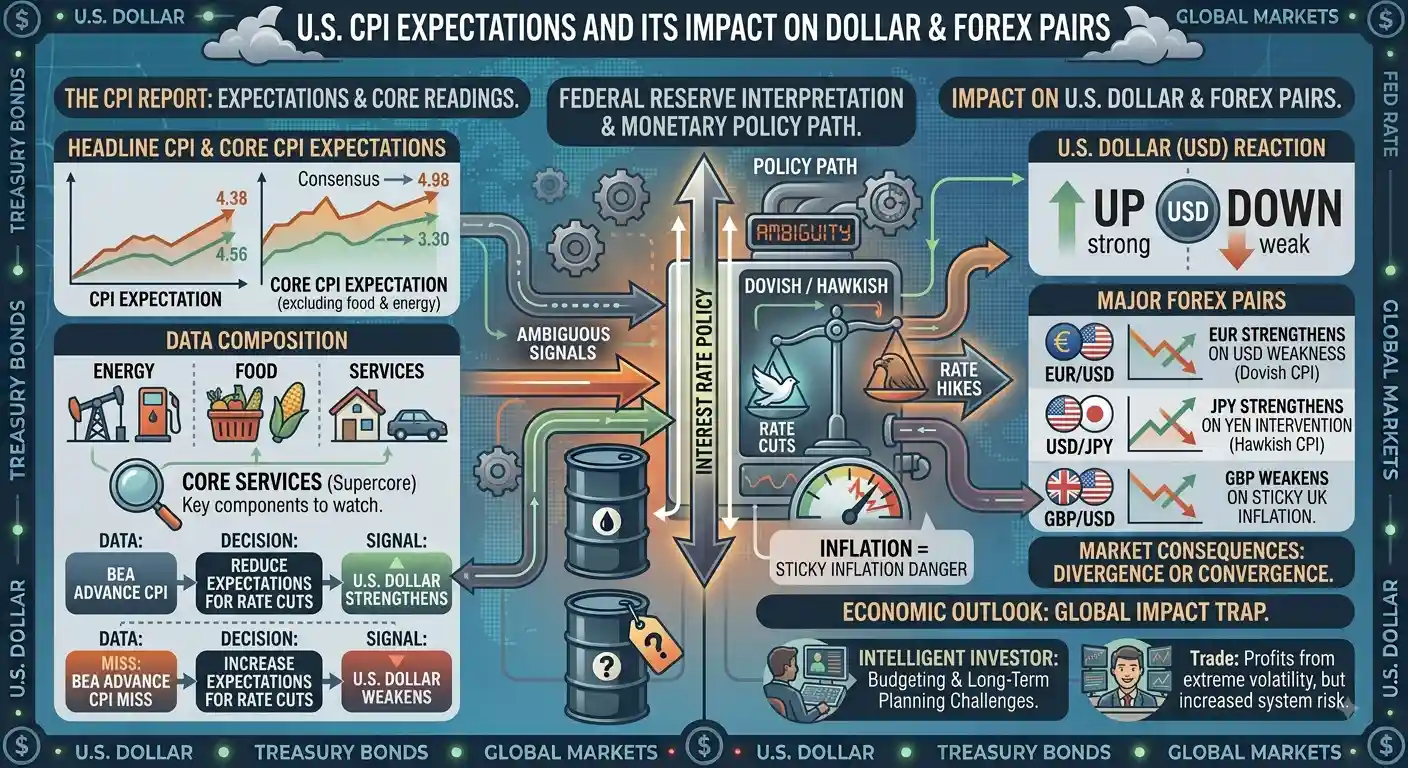
Wall Street consensus forecasts point toward a modest, controlled rebound in monthly consumer prices alongside a continued deceleration in annual inflation rates:
● Headline CPI (YoY): Forecasted to ease to 3.4% (down from 3.5% in June and a peak of 4.2% in May).
● Headline CPI (MoM): Expected to rise +0.1%, rebounding from June's sharp -0.4% drop.
● Core CPI (YoY - ex-food & energy): Expected to edge down to 2.5% (from 2.6% in June).
● Core CPI (MoM): Projected at +0.2% (rebounding from 0.0% flat in June)
Key Drivers Behind Today's Figures:
1. Energy Echo Effect: In May, direct military strikes and maritime disruptions involving the U.S. and Iran drove crude oil higher, causing U.S. headline CPI to spike to 4.2%.
A subsequent ceasefire in June led to a 9.7% monthly plunge in gasoline prices, pulling headline inflation down by 0.4% MoM. During July, pump prices was volatile as Middle East headlines fluctuated, but ultimately finished down roughly 2% to 3% on net, placing a moderate cap on headline inflation.
2. Core Normalization: Exceptional, record-setting price drops in motor vehicle insurance and wireless services artificially depressed core CPI in June. Analysts expect these transient distortions to normalize in July, bringing core MoM inflation back toward its 0.2% trend line.
Relevance for the U.S. Economy and the Federal Reserve
Today’s CPI report sits at the intersection of two opposing macroeconomic forces:
geopolitical energy supply shocks and domestic labor market cooling.
● Fed’s September Dilemma: At the late-July FOMC meeting, Federal Reserve officials maintained a "hawkish hold" at 3.50%–3.75%, absorbing three dissenting votes from regional Fed presidents who favored an immediate rate hike due to energy inflation risks.
● Labor Shift: However, Friday’s softer labor report showing net job losses and slowing wage growth severely diminished market expectations for near-term interest rate increases.
● Inflation Bar: If today's CPI confirms that core inflation is trending steadily toward the Fed's 2% target, central bankers will have the justification needed to keep policy on hold or begin discussing monetary easing to protect employment growth.
Scenario Analysis for the U.S. Dollar
Foreign exchange markets track CPI figures to re-price U.S. Treasury yield differentials. The margin of divergence from the 0.2% core MoM / 3.4% headline YoY baseline will determine the directional trend for the U.S. Dollar (USD) against major currency pairs (USD/JPY, EUR/USD, GBP/USD) and spot gold (XAU/USD).
Scenario A: Core CPI MoM prints at +0.3% or higher
● Macro Context: A higher than expected core reading proves that secondary inflation from last month's energy shock and service costs is sticking around. This completely neutralizes the dovish impact of Friday's soft labor report and re-ignites market bets for a Federal Reserve rate hike in September.
● Dollar Impact: Aggressive Bullish Spike.
○ USD/JPY: Advances sharply as rising Treasury yields widen the yield gap over Japan.
○ EUR/USD & GBP/USD: Slide under heavy selling pressure as international capital shifts back into dollar-denominated assets.
○ XAU/USD (Gold): Faces a steep pullback as spiking real yields raise the opportunity cost of holding physical bullion.
Scenario B: Core CPI MoM at +0.2%; Headline YoY at 3.4%
● Macro Context: The official release aligns smoothly with consensus estimates. It confirms that June's deflationary reading was not a fluke, and that underlying price pressures are gradually cooling in an orderly fashion.
● Dollar Impact: Moderate Consolidation. The U.S. Dollar trades in a narrow, range-bound channel. Foreign exchange markets quickly absorb the data, keeping the greenback soft against major currencies while markets shift attention to upcoming Retail Sales and Producer Price Index (PPI) releases.
Scenario C: Core CPI MoM prints at +0.1% or lower
● Macro Context: Core inflation misses expectations, coming in at or near zero for the second consecutive month. Paired with last week's weak labor market data, this confirms a dual slowdown in both employment and prices, clearing the runway for the Fed to consider dovish rate cuts.
● Dollar Impact: Broad-Based Dollar Sell-Off.
○ USD/JPY: Plunges as falling U.S. Treasury yields trigger an unwinding of long-dollar carry trades.
○ EUR/USD & GBP/USD: Surge past key technical resistance levels.
○ XAU/USD (Gold): Catches a strong bullish bid, propelled by lower bond yields and a weaker greenback.
Today's July CPI release is a critical turning point for global macro sentiment. By clarifying whether last month's war-driven energy shock has permanently passed into consumer prices, the report will establish the underlying trajectory for the U.S. Dollar and set the tone for central bank policy through the autumn.