Crude oil Paradox - Risk Premium, Supply Factor and Dollar Impact
 Jul 31st, 2026
 5 mins


The global energy market in late July 2026 presents a striking paradox. Even with full public knowledge that military conflict involving the United States and Iran remains active, crude oil prices continue to swing violently rather than cleanly trending in a single direction. Earlier in July, benchmark Brent crude plunged near $70 per barrel as traders priced out theimmediate geopolitical "risk premium". Fast forward to the end of the month, and oil is ontrack for a 20% monthly surge spiking past $89 to $90 per barrel following renewed missileexchanges, vessel attacks near crucial trade chokepoints, and sharp domestic stockpiledraws.
Why does crude oil remain so volatile when the fact of the ongoing war is already known?
The answer lies in the dynamic interplay between geopolitical risk premiums and hardphysical supply realities, and how this feedback loop propagates directly into the value of the U.S. Dollar.
1. Risk Premium Factors vs. Supply-Driven Factors:
What Is Driving the Volatility?
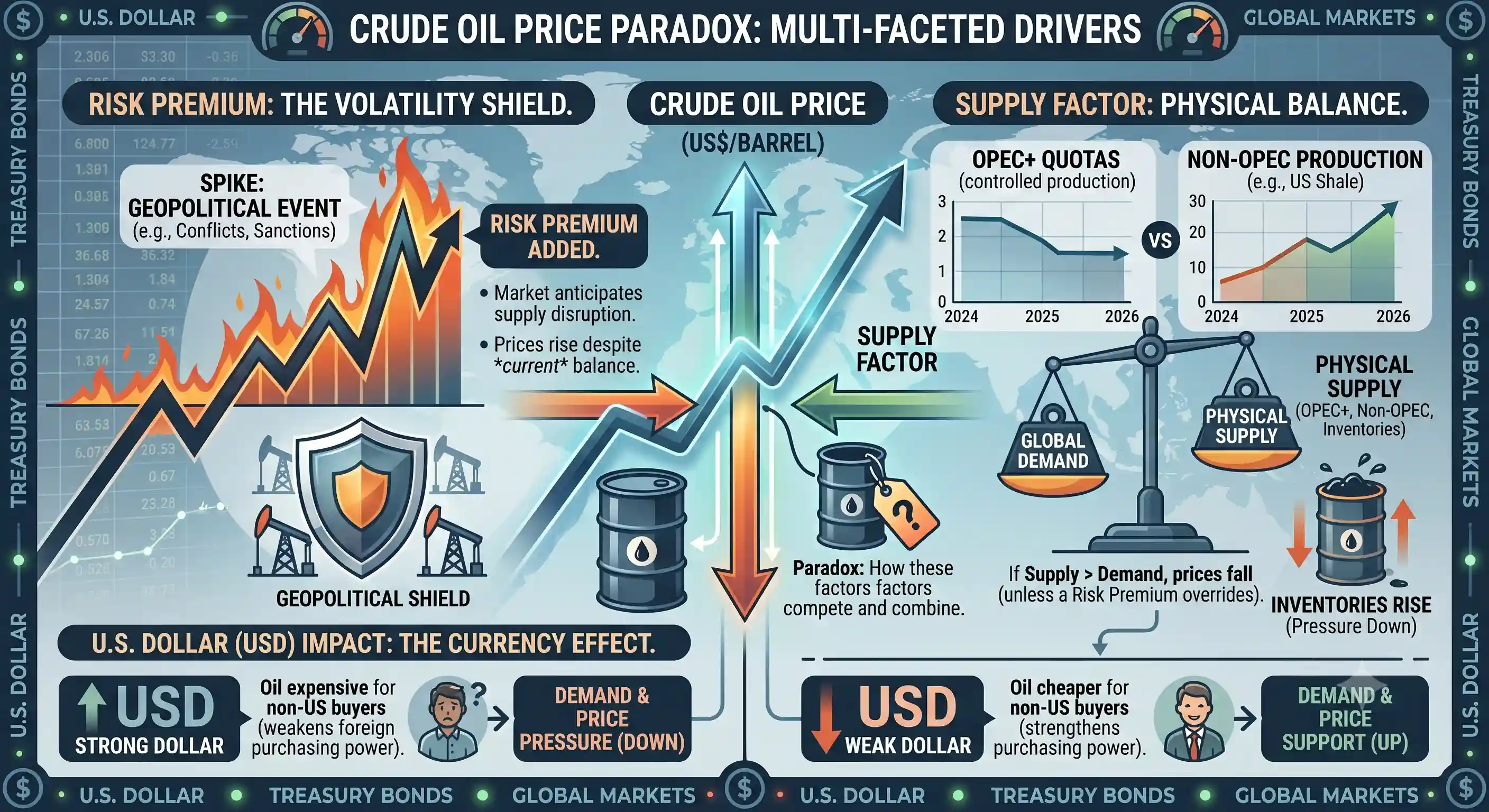
The volatility is not caused by the existence of war itself, but by the continuous,unpredictable shift between perceived geopolitical threat (Risk Premium) and actual physical barrel flows (Supply Realities).
A. Geopolitical Risk Premium: Headline Driven Volatility
The risk premium represents the extra price tag market participants pay to hedge against potential future disruptions. Even when market participants know a war is underway, the intensity and scope of that war fluctuate daily.
● Maritime Chokepoint Vulnerability: Over 20% of global oil flows through the Strait of Hormuz, with critical volumes traversing the Red Sea and Suez Canal routes. Whenever drone or missile strikes target commercial vessels or regional ports, insurance rates soar and tankers are forced to reroute around Africa.
● Headline Whipsaws: Because traders operate in real-time, diplomatic rumors (like temporary ceasefires) rapidly compress the risk premium. Conversely, retaliatory strikes immediately inject $5 to $10 of panic premium back into futures contracts within hours.
B. Physical Supply-Driven Factors:While headlines drive short-term spikes, physical supply-and-demand metrics decide where prices settle once the dust clears.
● Tightening Inventories: Highlighting the physical shortage, official U.S. EnergyInformation Administration (EIA) data confirmed a massive 7.2 million barrel drawdown in commercial crude stocks in late July, pulling domestic inventories to multi-year lows.
● Actual Physical Reductions: During peak friction, physical exports from Middle Eastern producers fell dramatically due to semi-blockades and restricted passage, preventing "paper" quotas from translating into actual physical deliveries.
● The Non-OPEC Cushion: Offsetting these physical disruptions is record-breaking production out of the Americas led by U.S. shale producing near 13.7 to 13.8 million barrels per day which acts as a structural ceiling preventing oil from staying above $100 indefinitely.
The extreme price swings happen because geopolitical risk sentiment acts as the short-term accelerator, while physical supply bottlenecks and inventory draws provide the hard baseline.
2. How Oil Volatility Affects the U.S. Dollar (USD)
Because crude oil is priced internationally in U.S. Dollars and serves as a primary input for global production and transportation, sharp swings in energy prices reverberate directly through foreign exchange markets.
1. Inflation and Interest Rate
● When Oil Spikes: A sudden rise in crude prices pushes up retail gasoline, diesel, and aviation fuel costs. This feeds directly into headline Consumer Price Index (CPI) numbers, threatening a secondary wave of inflation.
● Fed Effect: To prevent inflation expectations from becoming unanchored, the Federal Reserve is forced to maintain restrictive interest rates or signal potential rate hikes (as evidenced by the recent hawkish FOMC vote). Higher U.S. Treasury yields attract international capital seeking yield, driving up the value of the U.S. Dollar.
2. U.S. as a Net Energy Exporter
Unlike in past decades when the U.S. was purely a major energy importer, the modern U.S. economy is the world's top crude producer. Higher global oil prices improve the U.S. terms oftrade, expanding trade revenues for domestic energy exporters and reinforcing the greenback's fundamental support.
3. Safe Haven Asset Allocation
During periods when oil volatility is driven by acute military escalation, global investors frequently seek refuge in safe-haven assets. Because U.S. Treasury bills and dollar-denominated cash assets remain the primary global reserve haven, geopolitical shocks that trigger oil volatility simultaneously spark panic buying of the U.S. Dollar.
The ongoing volatility in crude oil is not an anomaly; it is the natural result of an unpredictable war where geopolitical headlines constantly re-price risk premiums, while tight physical inventories and maritime logistics dictate real-world supply availability.
As long as shipping lanes remain threatened and physical stockpiles operate near historical lows, energy markets will remain on edge—continuously driving inflation expectations, Federal Reserve policy expectations, and short-term momentum for the U.S. Dollar.